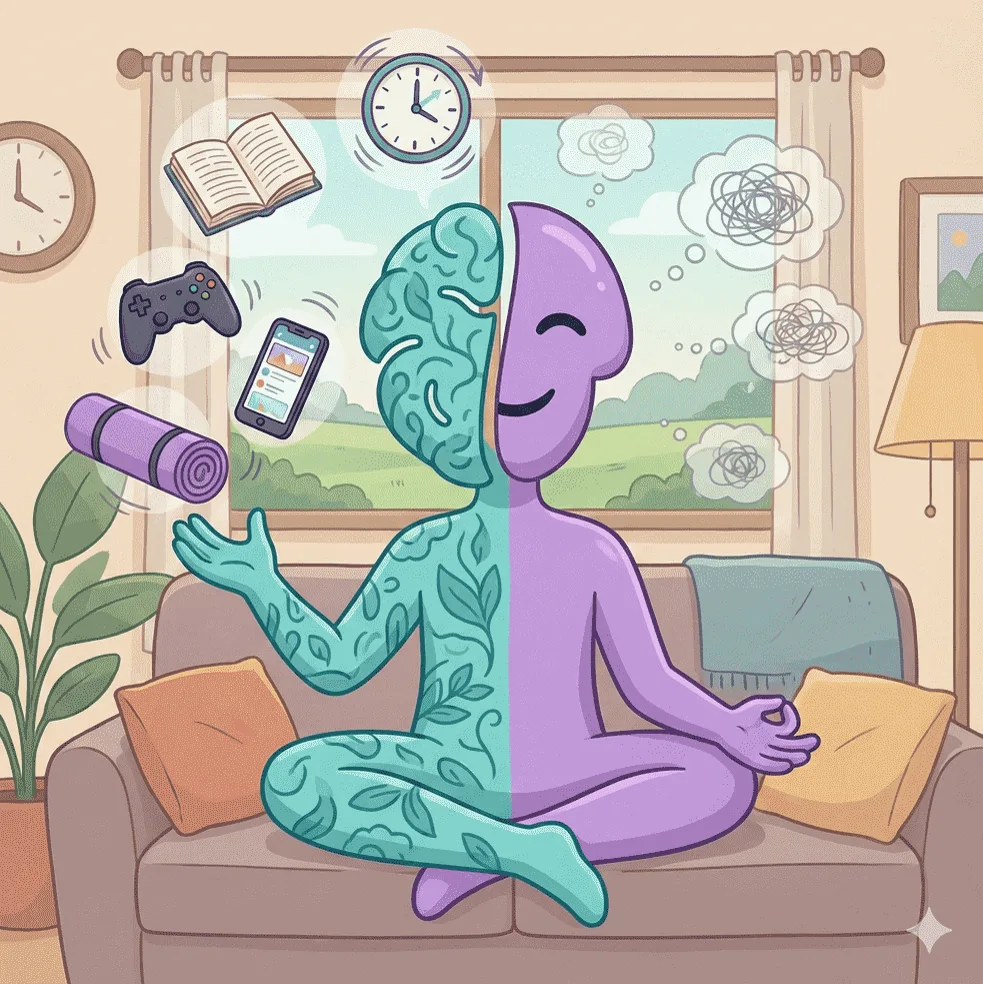
How mental hyperactivity hides an older wound
—Have you tried “doing nothing”?
My therapist’s question caught me off guard. I had been complaining for a while about something that may seem absurd from the outside: I was bored at home. But—and here is the twist—at the same time I had too many hobbies. Too many, and too demanding: creative projects, training courses, technical reading, exercise.
I was looking for a hobby I could do alone, at home, that demanded nothing of me physically or intellectually. A hobby to recover from my hobbies. Deep down, what I wanted was to be able to relax.
—Of course I have—I replied, with the confidence of someone who has spent years working on himself.
I described my attempts, rather proud of my repertoire: reading a book (but nonfiction, so I could learn something useful), playing video games (but on hard mode), doing yoga (but dynamic yoga, none of that lying down and breathing), watching a series (but taking mental notes because it was about psychology). She looked at me the way a mechanic looks at a customer who insists that “the car is making a tiny noise” while the engine is literally smoking.
—That is not “doing nothing.”
—That is not true—it slipped out of my mouth. It was an authentic response connected to the deepest part of me. All right, it was impulsive too. And what is more: I was certain it was not true! How dare she tell me that what I was doing was not doing nothing? What did she know? She looked at me, half amused, without saying a word, so I said:
—What do you mean, that is not “doing nothing”? If reading is not “doing nothing,” watching a series is not “doing nothing,” and yoga is not “doing nothing” either… then how on earth do you “do nothing”? How do you manage that?
—By doing nothing—she replied, with the calm of someone who knows exactly what she has just set in motion.
I stared at her like someone who has just been told that, to stop, you simply press the brake. Me, a psychotherapist specialising in ADHD. Me, with ADHD. Discovering in real time that I had no idea how to “do nothing.” That even when I thought I was resting, my mind kept looking for something to chew on. That stillness was not a place of rest for me, but an uncomfortable emptiness I had spent my whole life filling with activity.
And that session left me with a question I could not let go of: Why will my brain not let me stop?
What this article is about
If you recognised yourself in that scene, if you have ever looked for a way to rest and discovered that you do not know how to do it without doing something, I want you to know one thing: it is not a character flaw. It is not laziness in disguise. It is not that “deep down you do not want to stop.”
In this article, I want to explain why your mind works this way. Why stillness feels like a threat rather than a refuge. And why this has far more to do with how your brain developed, and with what you learned (or did not learn) about calm in your early years, than with your willpower.
"Si de verdad quisieras, pararías"
You have probably heard it. Or something like it: “You just do not organise yourself properly”, “You need to learn to switch off”, “The problem is that you do not prioritise”. As though relaxing were a decision you simply make. As though your brain came with an “off” switch that, for some mysterious reason, you refuse to press.
But here is the problem with that argument: it assumes that every brain works the same way. It does not.
For many people with ADHD, stopping is not difficult because they do not want to. It is difficult because their nervous system does not recognise stillness as a safe place. Willpower will not fix that. Understanding what is happening underneath can begin to.
What happens in your brain (the short version)
I am going to simplify the neuroscience considerably, but you need to know this:
The prefrontal cortex, the part of the brain just behind your forehead, acts like a “traffic controller.” It decides which thoughts get through, which are held back, which impulses deserve attention and which do not. In people with ADHD, this area matures later and works less efficiently.
The result? Thoughts, emotions and impulses pass through unfiltered. You do not think too much because you want to. Your brain has difficulty inhibiting what you do not need at that moment.
And here is the paradox: mental hyperactivity, that feeling that your head never stops, does not come from a brain that is “accelerated,” but from a brain that cannot brake. It is like a car without brakes: it is not moving fast because the engine is powerful, but because nothing can stop it.
The thermostat that does not work properly
But there is something else. Models such as Sergeant’s cognitive-energetic model or Sonuga-Barke’s hypothesis propose that ADHD involves an alteration in activation and alertness systems. Imagine that your brain has an internal thermostat regulating how much stimulation you need to function. In ADHD, that thermostat is miscalibrated.
This explains why many people with ADHD move between two seemingly opposite states:
- Overarousal: talking a lot, moving around, starting several tasks at once, feeling that you cannot stop.
- Underarousal or “shutting down”: feeling blocked or disconnected, staring into space, being unable to get started on anything.
The constant search for stimulation (novelty, screens, multitasking, self-imposed urgency, even conflict) thus becomes an unconscious attempt to self-regulate a neurobiological system that cannot find its own point of balance.
And here is the trap: this constant search is often accompanied by underlying anxiety, an internal noise that rarely disappears completely. Many people with ADHD do not know what it feels like to be serene because their nervous system almost never is.
The noise that never stops: scenes from a brain that cannot stop
If what I have just explained sounds abstract, let us make it concrete. These are scenes you will probably recognise.
Scene 1: Sunday afternoon
It is five o’clock on a Sunday afternoon. Nothing is urgent. In theory, you could rest. But you have been on the sofa for an hour and your head has not stopped for a second: you have mentally reviewed the coming week three times, remembered an email you forgot to send on Friday, wondered whether you should use the time to get ahead, opened your phone “just for a moment,” and spent twenty minutes jumping between apps without knowing what you were looking for.
Your body is still. Your mind is not.
What is happening: your prefrontal cortex is not filtering. Every thought that appears, however irrelevant, passes through unchecked. And because your activation system is underaroused (Sunday offers nothing urgent or novel), your brain looks for stimulation wherever it can: on your phone, in rumination, in compulsive planning.
Scene 2: “Sleeping bores me”
A patient once put it this way: “Sleeping bores me. With all the interesting things there are to do in the world, why would I want to switch off for eight hours?”
And I understand. For many people with ADHD, nighttime is the only part of the day when nobody interrupts them. The house is quiet, there are no external demands, and suddenly an energy appears that was not there during the day. Now you want to read, watch that series, start that project, or research the topic that interests you.
What is happening: when external pressure drops, your nervous system desperately looks for something to activate it. Sleep, which requires letting go of control and trusting the emptiness, feels like a threat. And at that hour, the guilt of “not having done enough today” may surface strongly, making you want to compensate with nighttime activity.
Scene 3: “Relax, you are on holiday”
You are at a family meal. You have been jiggling your leg, looking at your phone and getting up to fetch things you do not need. Someone says, “Come on, relax—you are on holiday.”
And you think: “If they knew how hard it is for me to sit here doing nothing…”
What is happening: your alertness system is underaroused. A long, unstructured meal, with nothing to do with your hands and no novel stimulation, is torture for a brain that needs constant activation. It is not that you do not want to be with your family. Your nervous system is shouting “give me something to do” while you try to look calm.
Scene 4: The list that grows while you “rest”
You decide to take some time for yourself. You sit down. You breathe. And then it begins: “I should use this time to reply to that message.” “Oh, and I need to look into the insurance.” “Did I lock the car properly?” “I could get the weekly shopping done early.” Within ten minutes, your “rest” has turned into a mental list of twenty tasks.
What is happening: when there is no external stimulation, your mind generates it. Stillness is not neutral for you: it is an empty space your brain automatically fills with unfinished tasks, worries and plans. And every item on that list comes with a small jolt of anxiety, because your system does not distinguish between “thinking about it” and “having to do it right now.”
Scene 5: The podcast for falling asleep
Every night, the same ritual: you get into bed, turn off the light… and put on a podcast. Or an audiobook. Or music. Or all three in rotation, depending on the night. Because if you do not, you know what happens: your mind takes off. You start reviewing the day, anticipating the next one, recalling conversations and having ideas that suddenly seem urgent.
Someone may have told you that “it is not healthy,” that you should learn to fall asleep in silence. But silence, for you, is not silence. It is amplified internal noise.
What is happening: when external stimuli (light, activity, conversation) disappear, your brain does not switch off; it desperately looks for something to hold on to. The podcast is not a whim: it gives your mind a controlled, predictable stimulus to occupy the space that would otherwise fill with rumination, mental lists or anxiety. It is, literally, a regulation aid. There is nothing wrong with using it while you learn other ways to find calm.
What if it were not a flaw in you?
At this point, I want you to pause.
Everything I have told you so far—the prefrontal cortex, the miscalibrated thermostat, the Sunday and podcast scenes—could read like a list of everything that is “wrong” with you. But that is not what I want you to take away.
I want you to consider another possibility: your difficulty relaxing is not a character flaw. It is the logical response of a nervous system that never learned that calm is a safe place. And to understand this, we need to talk about something rarely mentioned in discussions of ADHD: attachment.
How we learn to calm down (or do not)
The brain circuits that regulate attention, inhibition and alertness do not develop through genetics alone. They develop in relationship. A baby is not born knowing how to calm down; they learn through thousands of interactions with a caregiver who conveys, again and again, that emotional arousal can subside, that someone is there, and that the world is predictable.
This is called attunement. Attunement is what happens when a caregiver:
- Notices the baby’s emotional signals (crying, restlessness, smiling).
- Responds to those signals predictably and appropriately.
- Shares emotional states in real time: when the baby becomes activated, the caregiver helps them settle; when the baby is calm, the caregiver is present without intruding.
When this happens consistently enough—not perfectly, just sufficiently—the baby gradually internalises something fundamental: “When I become dysregulated, I can return to calm. Someone is there to help me. The world is a place where it is possible to be at ease.”
That experience, repeated hundreds of times, builds what we might call a body memory of calm. It is not a conscious memory. It is something deeper: a sense that stillness is safe, that being alone with yourself is not dangerous.
The trauma that does not look like trauma
This is where a concept that may be useful comes in: deficit trauma.
When we think of trauma, we usually imagine dramatic events: accidents, abuse, sudden loss. But there is another, quieter kind of trauma that is not about what happened, but about what was missing.
This kind of deprivation leaves no explicit memories. You cannot point to a moment and say, “That was it.” But it leaves implicit traces: a vague sense that something is wrong when everything is calm, a restlessness that appears when there is nothing to do, and difficulty being alone with yourself without seeking distraction.
In adulthood, these traces are reactivated. When you become still, your nervous system may interpret that stillness as a danger signal: “I am alone. Nobody is coming. I have to do something.” Then come the urgency, the mental list and the impulse to pick up your phone.
It is nobody’s fault (but it is real)
I want to be clear: this is not your fault. Nor is it necessarily your parents’ fault. Most caregivers do the best they can with what they have. Many grew up in environments where they did not learn to regulate themselves either, and where their own emotional needs were not met.
What matters is not finding someone to blame. What matters is understanding that what happens to you makes sense. That your difficulty relaxing is neither a moral failing nor a lack of willpower. It is the logical response of a nervous system that developed in a context where calm was not a safe place.
And understanding this changes the question.
It is no longer: “Why am I so incapable of relaxing?”
Now it is: “How can I teach my nervous system something it did not learn when I was young?”
What makes this so difficult
I wish I could tell you that understanding it is enough to make it change. But it does not work that way. Real traps keep this pattern in place.
0. The body that acts before you do
Before talking about psychological traps, there is something more basic: your body. Often, you do not even make a conscious decision “not to relax.” Your nervous system does it for you.
You are on the sofa, supposedly resting. Suddenly, without quite knowing how, you find yourself standing in the kitchen making your third sandwich of the day. Or reorganising a drawer. Or looking at your phone even though five minutes ago you promised yourself you would put it down. You did not decide to get up. Your body got up.
1. Self-esteem that depends on doing
If you grew up receiving the message—explicitly or implicitly—that your worth depends on what you produce, rest becomes a threat. Stopping means ceasing to prove that you have value.
2. Fear of rejection
Research shows that adults with ADHD have higher-than-average rejection sensitivity. If, in your mind, “stopping = not performing = disappointing someone = being rejected,” then rest is not neutral. It is dangerous.
3. An environment that does not understand
“You just do not organise yourself properly.” “You need to learn to switch off.” These phrases reinforce the idea that you are the problem.
4. The cycle that perpetuates itself
All of this forms a loop:
- Stillness activates internal distress (memories of failure, loneliness, rejection).
- Your nervous system responds by seeking stimulation.
- You keep moving constantly.
- That confirms that “you only have value if you are doing something.”
- You return to point 1.
Breaking this cycle is not easy. But it is possible.
What can be done (for real)
I am not going to give you a list of productivity tips. What you need is not another task app or an organisational method. You need to teach your nervous system that calm exists and can be safe.
At an individual level
- 1. Give your brain controlled, not chaotic, stimulation: If you need a podcast to sleep, use it. The aim is not to eliminate stimulation, but to choose it consciously. The useful question is: Does this stimulus regulate me, or dysregulate me further?
- 2. Practise stillness in tiny doses: Do not try to meditate for an hour. Begin with gradual exposure: 30 seconds looking out of the window without your phone. The aim is not to “relax.” It is to show your nervous system that stillness will not kill you.
- 3. Identify what appears when you stop: When you notice the urge to fill the emptiness with activity, pause and ask yourself: What am I avoiding feeling right now? Naming what appears is the first step towards no longer running from it.
At a relational level
- 4. Communicate what you need: Explain to the people around you: “When I have nothing to do, I do not rest; I become more activated. What helps is having something gentle to focus on, not total emptiness.”
- 5. Seek relationships that regulate rather than demand: Part of learning to calm down is having experiences of shared calm with others. Being with someone without having to perform, impress or entertain.
At a structural level
- 6. Consider therapy as a space for regulation: A good therapeutic process offers you a relationship in which you can experience what it feels like to be with someone who sees you without judging you and can tolerate your silences.
- 7. Do not rule out medication if you need it: If your difficulty regulating yourself is severe, medication can help your prefrontal cortex function better. Talking to a professional about this is not giving up. It is being realistic.
The radio transmitter
Do you remember the scene at the beginning? My therapist asking whether I had tried doing nothing. Me, convinced that I had. And then the uncomfortable discovery that I had no idea how to do it.
Now, months later, I understand it better.
My mind is like an old radio transmitter whose antenna was never properly tuned. Instead of picking up a clear, reassuring signal, it mostly receives static. For years, my way of dealing with that noise was to turn the dial frantically—not to find a better station, but to drown out the noise coming from within.
What my therapist was asking me, without putting it this way, was: Can you stop turning the dial for a moment and simply listen to the noise?
And the honest answer was no. I could not. I did not know how. My nervous system had not learned that silence could be safe.
But here is the good news: the wiring can be worked on. I keep trying. Now, when I want to watch a film, I switch off my phone and put it in a drawer. And I have started doing something else. In the evenings, I sit on the sofa for a while. Dim light. No phone. No podcast. Just me.
I do not know whether that counts as “doing nothing.” But I think it comes close. And little by little, my nervous system is learning that this time is not dangerous. That nothing bad happens when I am still.
I have not arrived yet. But I no longer believe that not knowing how to get there is a flaw in me. And that, somehow, is already a form of rest.
Questions to keep thinking about
Before you close this tab and move on to something else (I know the urge is there), I want to leave you with a few questions. Not so that you answer them now. Just so that you carry them with you:
- What appears when you become still? What sensation, what thought, what emotion?
- When was the last time you rested without feeling that you should be doing something else?
- Is there someone you can be with without having to perform, impress or entertain?
- What if difficulty stopping were not a flaw in you, but something you can learn to work on?
Further reading
If you would like to understand the science behind what you have read, here are some key references:
On adult ADHD and self-regulation:
- Kooij, J.J.S. et al. (2019). Updated European Consensus Statement on diagnosis and treatment of adult ADHD. European Psychiatry, 56, 14-34.
- Barkley, R.A. (2015). Attention-Deficit Hyperactivity Disorder: A Handbook for Diagnosis and Treatment (4ª ed.). Guilford Press.
- Shaw, P. et al. (2007). Attention-deficit/hyperactivity disorder is characterized by a delay in cortical maturation. PNAS, 104(49), 19649-54.
On boredom aversion and stimulation seeking:
- Orban, S.A., Faraone, S.V. & Harari, G.M. (2025). Why are individuals with ADHD more prone to boredom? Journal of Attention Disorders.
- Danckert, J. & Eastwood, J.D. (2020). Out of My Skull: The Psychology of Boredom. Harvard University Press.
- Sergeant, J.A. (2000). The cognitive-energetic model: An empirical approach to ADHD. Neuroscience & Biobehavioral Reviews, 24(1), 7-12.
On attachment, attunement and relational trauma:
- Feldman, R. (2007). Parent–infant synchrony: Biological foundations and developmental outcomes. Current Directions in Psychological Science, 16(6), 340-5.
- Sroufe, L.A. et al. (2005). The Development of the Person: The Minnesota Study of Risk and Adaptation from Birth to Adulthood. Guilford Press.
- McLaughlin, K.A. et al. (2017). Neglect as a violation of species-expectant experience: Neurodevelopmental consequences. Biological Psychiatry, 82(7), 462-71.
On self-esteem and rejection sensitivity in ADHD:
- Cook, J. et al. (2014). The self-esteem of adults diagnosed with ADHD: A systematic review. ADHD Attention Deficit and Hyperactivity Disorders, 6(4), 249-68.
- Crocker, J. & Wolfe, C.T. (2001). Contingencies of self-worth. Psychological Review, 108(3), 593-623.
- Gao, S. et al. (2017). Associations between rejection sensitivity and mental health outcomes: A meta-analytic review. Clinical Psychology Review, 57, 59-74.
This article was originally published on divergentbrain.org. This content is for information only and does not replace an individual professional assessment or care.